
Magnetic Garage Door Screen: Best Options & How to Install
Shopify APIA garage is one of the most useful spaces in a home — workshop, gym, storage, hobby room. The problem is that an open garage door invites every flying insect in the neighbourhood. A magnetic garage door screen solves this: you get full airflow and daylight with a mesh barrier that closes automatically behind you. If you're still comparing screen types for the rest of the house, start with our guide to the best magnetic screen doors of 2026.
Why Garage Door Screens Are Different
A standard garage door opening is significantly larger than a regular door — typically 8–10 feet wide and 7–8 feet tall for a single car, up to 16 feet wide for a double. This creates challenges that standard door screens don't face:
Size. No off-the-shelf magnetic door screen covers a 10-foot opening. Garage door screens need to be purpose-made for the size.
Weight. A screen that large needs heavier mesh and more robust attachment to stay in place without sagging.
Entry points. Garage door screens typically use a center seam closure (like standard door screens) but need more magnets and a stronger seam to close reliably across a wider span.
Drive-through use. Some garage screens are designed to allow cars to pass through; others are walk-through only. Know which you need before buying.
Garage Door Screen Sizing: Single vs Double
Garage openings come in a handful of standard sizes, but "standard" varies enough that measuring is not optional. Order to the opening, not to the door.
| Opening | Typical width | Typical height | Notes |
|---|---|---|---|
| Single car | 8'–9' (some 10') | 7'–8' | Most common residential size |
| Double car | 16' (some 18') | 7'–8' | One wide screen or two panels |
| RV / oversized | 10'–12'+ | 8'+ | Almost always custom |
How to measure. Measure the width and height of the finished opening — the space the door closes into — not the door panel. Take the width at the top and bottom (older frames aren't square) and use the larger figure. For height, measure from the header down to the floor; garage screens run to the ground rather than stopping at a sill.
Where the header attaches. Most kits mount to the inside face of the header (the beam across the top of the opening) or to the wall just inside it. Confirm you have a flat, cleanable surface there — exposed track hardware or trim can get in the way and is worth checking before you buy.
Why odd sizes go custom. A 9'6" or 17' opening falls between the standard single and double kits, leaving either a gap or a bunched-up overlap. If your opening isn't a clean single or double size, a made-to-measure screen avoids the compromise.
Best Magnetic Garage Door Screen Options
CoverWith Custom — Best for Non-Standard Sizes
CoverWith makes custom magnetic screens to exact measurements, including garage door openings. For garages with non-standard dimensions or anyone who wants a precise fit without edge gaps, this is the right option. The fiberglass mesh and industrial hook-and-loop attachment handle the larger format well.
For a standard single-car garage (9' × 7'), a custom CoverWith screen provides full coverage with no gaps at the edges — the main failure point of generic garage screens.
Best for: Non-standard garage sizes, anyone who needs a guaranteed fit.
Garage Door Screens (Purpose-Built Double-Panel)
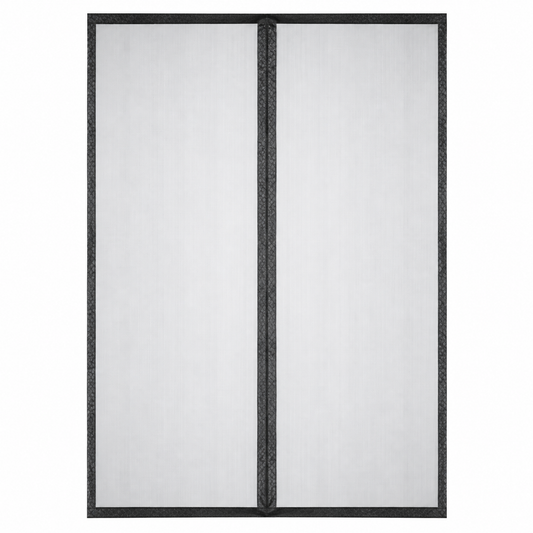
Several brands make purpose-built garage door screens in standard garage sizes. These typically use two wide panels with a center zipper or magnetic closure and a top header that attaches across the garage door opening.
Key features to look for:
- Fiberglass or polyester mesh rated for outdoor use
- Weighted bottom hem to prevent billowing
- Walk-through zipper or magnetic center seam
- Attachment system compatible with your garage door frame
Standard sizes: 10' × 7' (single), 16' × 7' (double). Measure your opening before ordering — garage door dimensions vary.
Typical price range: $40–80 for standard sizes.
DIY Two-Panel Approach
Some homeowners use two standard magnetic door screens side by side to cover a single-car garage opening. This works with caveats: the screens need to be mounted at the same height, the center seams of each screen need to align with each other, and there will be a gap where the two screens meet.
For workshop or hobby use where occasional insect entry is tolerable, this is an inexpensive option. For serious bug exclusion, a purpose-built solution works better.
Magnetic vs Zipper vs Roll-Up Garage Screens
Garage door screens close in three main ways. The right one depends on how you use the garage — walk-through only, or drive-through too.
| Type | Entry | Drive-through | Wind resistance | Best for |
|---|---|---|---|---|
| Magnetic center seam | Hands-free walk-through | No | Moderate (needs weighted hem) | Workshops, gyms, frequent foot traffic |
| Zippered panels | Unzip to pass | Full open for a car | Good (zips shut tight) | Garages used for both parking and hanging out |
| Roll-up / retractable | Roll down when needed | Depends on model | Good (tensioned frame) | Occasional use, tidy stow-away |
Magnetic is the most convenient for constant in-and-out — the seam closes behind you automatically — but it relies on a good bottom weight to stay put in a breeze across a wide opening.
Zippered screens seal tightest and let you open the full width for a vehicle, at the cost of having to zip and unzip each time.
Roll-up systems tuck away when you want the garage fully open, but cost more and add hardware across the top.
For a garage used mainly as a living or work space with regular foot traffic, a magnetic center-seam screen is usually the practical pick. If you park in the same bay you screen, a zippered drive-through panel avoids taking the screen down every time.
How to Install a Magnetic Garage Door Screen
The process mirrors a standard door install with a few large-format tweaks. If you want the full step-by-step first, see our magnetic screen door installation guide.
What You'll Need
- The screen kit (usually includes header bar, side rails or tape, and the mesh panels)
- Measuring tape
- Drill (for header bar installation)
- Level
- Isopropyl alcohol for surface prep
Installation Steps
Step 1 – Measure the opening. Measure the width and height of your garage door opening — the space inside the frame, not the door itself (our measuring guide covers how to do it). Standard single-car: 9–10' wide × 7' tall. Standard double: 16–18' wide × 7' tall.
Step 2 – Clean the frame. Wipe the top and sides of the garage door frame with isopropyl alcohol. Dust, grease, and paint residue prevent adhesive from bonding. Allow to dry fully.
Step 3 – Attach the header. Most garage door screen kits include a header bar that spans the top of the opening. Drill into the frame at the top, level the bar, and secure it. This is the primary load-bearing point — get it level or the screen will hang crooked.
Step 4 – Hang the panels. Attach the mesh panels to the header and press the side edges against the frame using hook-and-loop tape or the included clips. Work from top to bottom, keeping the mesh taut.
Step 5 – Weight the bottom. Garage door screens need a weighted hem at the bottom or a ground attachment to prevent billowing. Press the bottom edge against the floor threshold or attach a ground anchor if included.
Step 6 – Test the center closure. Walk through the center seam and confirm it closes fully behind you. Check all four edges for gaps.
Tips for Getting More Life from a Garage Screen
Remove it in winter. Magnetic garage screens aren't designed for cold weather or snow load. Take it down before temperatures drop and store it flat.
Reinforce the header attachment. The header takes the most stress. Check the screws or anchor points every few months and tighten as needed.
Clean the mesh periodically. Garage environments are dusty. A clogged mesh restricts airflow and puts more stress on the attachment points. Hose it down or vacuum it lightly every few months.
FAQ
Can you put a screen on a garage door? Yes. Purpose-built garage door screens attach to the door frame and cover the opening when the garage door is raised. They don't attach to the door itself.
What size garage door screen do I need? Measure the width and height of your garage opening. Standard single-car openings are 9–10 feet wide × 7 feet tall. Double garages run 16–18 feet wide. Order a screen that matches your measurement.
Do magnetic garage door screens keep mosquitoes out? Yes, when properly fitted. The main entry points are edge gaps and the center seam. A well-fitted screen with a fully closing center seam keeps mosquitoes and most flying insects out effectively.
Can a car drive through a garage door screen? Some garage door screens include a drive-through zipper designed to open fully for vehicles. Standard walk-through screens are not designed for car access and will be damaged if driven through.
How do I stop a garage screen from blowing in the wind? A weighted bottom hem and ground attachment are the most effective solutions. Some screens include tie-down straps that anchor the sides to the garage floor.
What size is a standard garage door screen? Single-car garage screens are built for openings around 8–10 feet wide by 7–8 feet tall; double-car screens run about 16–18 feet wide. Because "standard" varies, measure your finished opening before ordering rather than assuming a size.
What's the difference between a magnetic and a zippered garage door screen? A magnetic screen closes hands-free at a center seam — best for constant walk-through use. A zippered screen seals tighter and can open the full width for a car, but you have to zip it each time. Choose magnetic for foot traffic, zippered if you also drive through the opening.
Final Thoughts
A magnetic garage door screen converts your garage into a usable, ventilated space during warmer months without the insect problem. For standard garage sizes, purpose-built two-panel screens offer good coverage at a reasonable price. For non-standard openings or anyone who needs a precise fit, CoverWith's custom option handles the sizing cleanly. Install the header bar carefully, prep the frame surface properly, and weight the bottom — those three things determine whether a garage screen works well or poorly.