
How to Install a Magnetic Screen Door (Step-by-Step Guide)
Shopify APIInstalling a magnetic screen door takes about 15 minutes and requires no tools — just a clean surface, some patience getting the alignment right, and the screen that came in the box. Here's exactly how to do it.
What You'll Need
- Your magnetic screen door (and everything in the box — check for the hook-and-loop tape strips, thumbtacks, and any push pins)
- Isopropyl alcohol or a damp cloth
- A tape measure
- Scissors (for trimming if needed)
Most magnetic screens come with two types of attachment: adhesive hook-and-loop tape (for the frame) and thumbtacks or push pins (as a backup or for wooden frames). You'll use the adhesive tape as the primary method.
How to Install a Magnetic Screen Door: Step-by-Step
Step 1 – Measure Your Door Opening
Before you touch the adhesive backing, confirm the screen fits. Measure the width and height of your door opening (the space inside the frame, not the door itself).
Standard doors run 32"–36" wide and 80" tall. If your opening is significantly outside that range, a standard screen may not cover it fully — check the manufacturer's stated coverage before proceeding.
Step 2 – Clean the Door Frame
This is the step most people skip, and it's why screens fall down. The adhesive on hook-and-loop tape bonds poorly to dust, grease, or paint residue.
Wipe down the top and both sides of the door frame with isopropyl alcohol or a clean damp cloth. Let it dry fully — at least 2–3 minutes — before applying any tape.
Step 3 – Attach the Hook-and-Loop Tape to the Frame
Peel the backing off the adhesive side of the hook tape strips and press them firmly along the top and both sides of the door frame. Start at the top center and work outward, then do the sides from top to bottom.
Press hard along the full length — not just at the ends. Run your thumb firmly along the entire strip to ensure full contact.
Tip: If your frame is painted wood, the adhesive may not bond as strongly. Use the included thumbtacks at regular intervals (every 6–8 inches) as a backup.
Step 4 – Attach the Loop Side to the Screen
The other half of the hook-and-loop system attaches to the edge of the screen itself (this is usually pre-sewn or pre-attached — check your specific model). Align the screen so the loop tape meets the hook tape on the frame.
Start at the top center and press the screen into place across the top, then work down each side.
Step 5 – Align the Center Seam
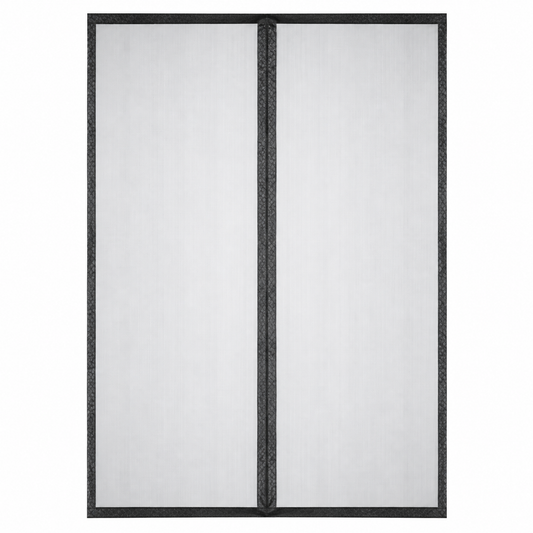
The two panels of the screen meet at a center seam held together by magnets. Before pressing the sides fully into place, let the screen hang freely and check that the magnets are aligned — they should close in a straight vertical line.
If the seam is off-center or the panels hang unevenly, adjust the top attachment slightly left or right until the seam sits straight.
Step 6 – Secure the Bottom
Most magnetic screens include a weighted bottom hem or a separate strip of hook-and-loop for the floor. If your screen touches the floor, attach the bottom strip to the threshold. If there's a small gap at the bottom, that's acceptable — insects generally don't enter from below on an active doorway.
For a gap larger than 1 inch at the bottom, check if the screen is hung too high and readjust from the top.
Step 7 – Test It
Walk through the screen several times in both directions. The magnets should close fully behind you within 1–2 seconds. Check all four edges for gaps — the screen should sit flat against the frame with no visible openings.
If the center seam isn't closing fully, check that the magnets haven't been separated (some screens have magnets at fixed intervals — make sure none are folded back on themselves).
Common Installation Mistakes
Skipping the frame cleaning. This single step is responsible for most magnetic screens that fall down within the first week. Always clean and dry the frame before applying tape.
Pressing only the ends of the tape. The adhesive needs full-length contact to hold. Run your thumb firmly along every inch of tape after applying.
Not checking the seam alignment before finalising. Once the sides are fully pressed down, adjusting the seam alignment means pulling everything off and starting over. Get the seam straight before committing.
Installing over an existing screen. Magnetic screens are designed to be the only screen on the opening. Trying to overlap them with existing mesh creates gaps and defeats the purpose.
Wrong size. The most common reason a magnetic screen doesn't work well is that it doesn't actually fit the opening. If the screen is narrower than the opening, no amount of careful installation fixes the edge gaps.
What If My Door Is a Non-Standard Size?
Standard magnetic screens are designed for openings up to 38"–40" wide and 82"–83" tall. French doors, sliding glass doors, tall ceilings, and older homes often have openings outside these dimensions.
For non-standard openings, a custom-made screen is the practical solution. CoverWith makes magnetic screens to your exact door dimensions — you submit the measurements and the screen is cut to fit, eliminating the edge gaps that come with forcing a standard size into a non-standard opening.
FAQ
How long does it take to install a magnetic screen door? Most installations take 10–20 minutes. Cleaning the frame and waiting for it to dry is the longest part. The actual attachment takes under 10 minutes once the surface is ready.
Do magnetic screen doors need screws? No — the adhesive hook-and-loop tape is the primary attachment method. Most kits include thumbtacks or push pins as a secondary option for wooden frames, but screws aren't required.
Can I install a magnetic screen door on a metal frame? Yes. The adhesive tape bonds well to clean metal. Make sure there's no anodising residue or grease on the frame surface before applying.
How do I stop my magnetic screen door from falling down? The most common cause is inadequate surface prep. Remove the screen, clean the frame thoroughly with isopropyl alcohol, let it dry, and reapply the tape with firm full-length pressure. Use thumbtacks as backup if the frame is painted.
Can I reuse a magnetic screen door after removing it? The screen itself is reusable. The adhesive tape may lose strength after removal and might need replacing — replacement hook-and-loop tape rolls are widely available for a few dollars.
Final Thoughts
Magnetic screen door installation is genuinely simple when the surface prep is done properly. Clean the frame, apply the tape with full-length pressure, align the seam before committing, and test it thoroughly before considering the job done. Most installation failures come down to one skipped step — usually the cleaning.
If your door opening is outside standard dimensions, a custom-fit screen from CoverWith will always outperform a standard screen forced to cover an opening it wasn't made for.